Showing posts with label hotel. Show all posts

Friday, June 29, 2012

Day 28: Quiet


Saturday, June 9, 2012 

I brought my loom back to the Penzion with me last night. After I woke up this afternoon, I finished tapestry number 3, then spent the rest of the day (what little there was) drawing comics on my laptop. Another lazy Saturday. 

Prague - or the district we're in, at least - seems to shut down almost completely on Saturdays. Most of the stores are closed, and traffic is nearly nonexistent except on the main streets. 


When I got hungry, I walked a few blocks - the weather was gorgeous, the streets practically deserted - to get a few slices of pizza for lunch. (Giallo Rosso, the tiny hole-in-the-wall pizzeria near the Metro stop, lets you get pizza by the slice. The ham and spinach variety is my current favorite.) I ate them in the park while watching pigeons - it's amazing how different they all are if you look closely - and listening to children playing in the fountain on the other end. To paraphrase Terry Pratchett, it's a pleasant sound when you can't hear what they're actually saying. 


After pizza, I walked back across the street to the bakery next door to the pizza place and got a slice of chocolate cake, which I ate while looking out the front door at much the same view. Delicious. On the way back to the Penzion, I checked the hours of the Vietnamese place - it's one of the restaurants that's open on Saturdays - and stopped at the corner potraviny to get some shampoo to refill my nearly empty bottle. 

This is what I love about living in a city. Anything you need is within walking distance - usually several of what you need, and even more if you count places you can get to by the Metro. Lunch, dinner, a visit to the park, and a brief shopping trip today made for a total of maybe twenty minutes of walking, and I could have done it in less if I'd done less wandering around. 

Of course, the downside of living in a city is that everything is also within walking distance of several thousand other people, so it's hard to get any privacy. 

That's why I had dinner at Bong Sen again. It's one of the friendliest - and even more so, the quietest - restaurants I've ever visited. In a city full of noisy bars, crowded restaurants, and hotels full of college students (which can get noisy sometimes), it is an oasis of peace and good food. 

Of course, I've only been there after 9:30 pm, which might have something to do with it. For the sake of their business, I hope it's busier during the day. 

Tonight, I was one of only three customers in the restaurant; after I'd finished my rice and vegetables (69 crowns, or about $4 - it's also one of the only restaurants in the entire city where you can get dinner for less than 100), they let me stay and write until closing time (10:30). This one hour might end up being the source of five or six future Hamjamser posts. 

I might have found a place to go regularly. It's a shame I won't be able to do so after I return home. In the meantime, if you're ever in Prague, the address is Řipska 19, Vinohrady. Stop here for dinner at least once. 

Wednesday, June 13, 2012

Day 17: Morning


Tuesday, May 29, 2012 

A relatively uneventful day. In the fibers class, I starched my lace design, then pulled out roughly fifteen hundred thousand billion pins to release it from the pillow. (Yesterday's photo was taken after this, obviously. Why did I make a design with so many curves and intersections? Because I like the way it looks, that's why…) 

The starching went well, though, and we then started carving our designs for the upcoming blue-printing project. We don't have time to learn how to carve the forms out of wood, the traditional way, so we're using blocks of foam instead. It's certainly much easier to carve. 

Other than a long-awaited Skype call and a few hours of reading webcomics, I didn't really do much else today. Instead, I thought those of you who read this weblog might be interested to see the route I take every morning. 


I start at the Penzion. 


Our room is on the other side of the building, so you can't see the windows from here. The street it's on is just about wide enough for two cars to pass each other, as long as they're small. Like all of Prague, there are frequently people walking assorted dogs on the sidewalks. Watch where you step. 


From here, you turn right and walk toward the TV tower with the giant baby sculptures on it. It's about five times as tall as anything else in the city, so it makes a good landmark. 


There are some interesting murals on the left. 


Planning ahead for lunch, I often stop to get an inexpensive pastry of some kind at this bakery. 


The Metro is down here, at the bottom of what appears to be the third longest escalator in the world. People occasionally roll things down the dividers between the railings. 


In the confined spaces beneath the city, you can feel the wind rushing out of the tunnel before you can even hear the train itself. 


Like any urban public transportation, the train gets more and more crowded as it approaches downtown in the morning. There are rarely any empty seats. 


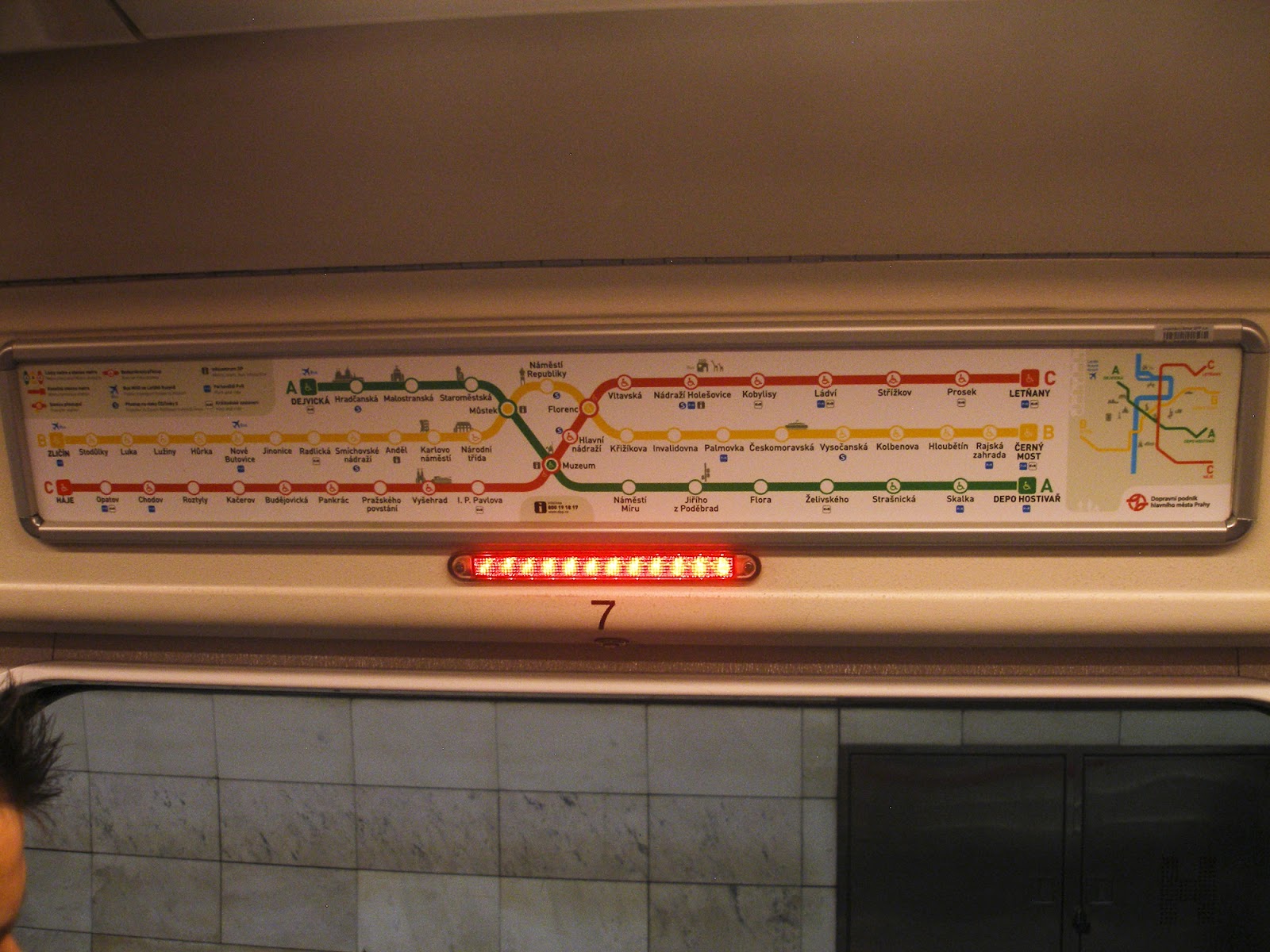
These handy charts are posted above every door. We get off at Můstek. 


There's one inactive escalator at nearly all the Metro stops; the middle one at the Můstek stop seems to have been completely ripped out. 


I assume it's for repairs. 

At the top of a much shorter escalator (the ground is lower here by the river), you come out into the Old Town. 


There's an open-air market that spans two or three blocks, with booths selling fruit and chocolates and cackling witch marionettes. They're usually still setting up when classes begin. 


Through Uhelny Trh, the little triangle at the end of the market… 


Down a narrower side street, past assorted restaurants… 


Through the archway between the jeweler and the violin shop… 


And you come out into the quiet yellow courtyard that the Institute overlooks. 


Most of the windows you can see here are part of the Institute. It shares the courtyard with a tea room (to the left) and an art gallery (to the right). The main Institute entrances are also to the right.  


The door on the left leads to a common room, a computer lab, one of the five miniature kitchens, and the non-design classrooms. The design studios are up the stairs and through the metal gate. The door under the chicken leads to the art gallery, which occupies a space somewhere beneath/behind/between the Institute. I'm not really sure how it all fits together. 

Through the gate, up some stairs, past a balcony, through another door, and you come out into the main hallway, which also functions as part of the Institute's library.


At the end is the chain of odd little trapezoid-shaped rooms occupied by the fibers studio. Here's the view from near my desk… 


And my desk itself, right by the door, looking uncharacteristically tidy this morning. 


Tuesday, June 12, 2012

Day 15/16/17: His Only Desire


Monday, May 28, 2012 

Today, I ate breakfast before going to the studio to start work on my lace project. I'd finished the sketch yesterday but hadn't had time to start weaving. The project was due Tuesday morning. 

I took a half-hour break to use the restroom and get a sandwich for dinner at the closest affordable place I could find. 

I skipped lunch. 

I had to stop for perhaps another half-hour to ride the Metro back to the Penzion. 

That was all. Other than that, I worked on my lace project all day and all night. I worked in the studio until the Institute closed. I worked in the hotel room until my roommates came back and needed to sleep. I worked on a chair in the hallway outside, clicking away as the late-night wanderers among the students gradually trickled back into their own rooms, expressing surprise and occasionally concern to find me still working at such a late hour. 

I like to listen to music while I work, to occupy the part of my (left) brain that's in charge of distractions. I've found that, after a certain point, it becomes easier to keep focused on a project if I simply listen to the same song over and over again. The song for this project was one by the incomparable Kirsty MacColl (repeated 61 times, according to my laptop). It worked quite well. 

I finished just before dawn (not as late as you might think, since we're quite far north here and the days are a few hours longer than they are back home) and climbed quietly into bed for several hours of deep sleep. I felt like I'd earned it at that point. 

There is a certain fierce joy that comes only from this kind of stubborn, sustained effort. If I tried to do it routinely - or even twice in the same week - I suspect it would kill me; but every once in a while, it becomes necessary to throw all the time and energy I have into a project, casting everything else aside for one unceasing burst of creative work. I love it when it happens. There is nothing quite like it. 

And the result was this: 


So I'm satisfied. 

Day 14: Excursion, Day 3


Saturday, May 26, 2012 

Slavonice


We spent the night in Slavonice (pronounced SLAV-o-nit-seh), in a hotel run by a man and a woman who were two of the sweetest people I've met here. They gave us all an absolutely enormous breakfast. Bread! Cheese! Meat! Vegetables! Coffee! Cake! Two kinds of cake! Seconds and thirds of everything! When we left, thoroughly stuffed, they urged us to take more. They spoke just enough English, and we spoke just enough Czech, for us to tell them that we were students from America. They hadn't heard of North Carolina, though.

We had planned a few extra stops today, but everyone loved Slavonice so much that we decided to stay there for the whole morning instead. We all spent the morning wandering the town's slanted little streets and taking photographs.


It's a beautiful place; there are buildings as ornate as the ones in Prague next door to simple little gray-stucco cottages, twisting little streets and passages, a tall clock tower, crumbling castle ruins with birds nesting in the crevices, cats sleeping and sheep grazing in the cluttered little backyards nearby.


Once you get more than three or four blocks past the lovely town square (triangle), the houses give way to farmland and ancient, wildflower-sprinkled cemeteries.


Some of the other students walked all the way out into the fields and took pictures of hills and newly sprouting crops stretching all the way to the horizon. I went back to wander through some more of the quiet little back streets. 


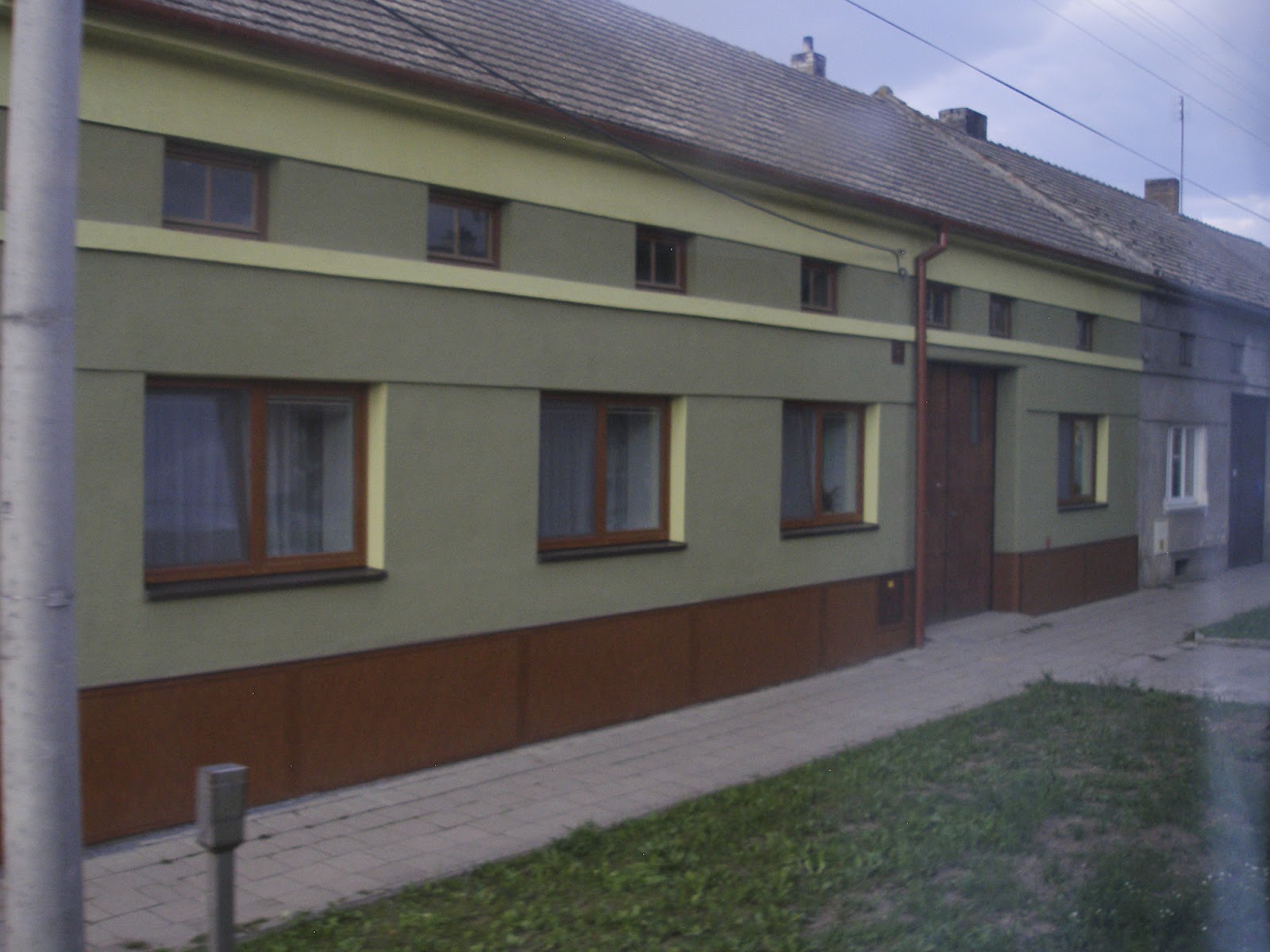
It's been interesting to see how the buildings look in places smaller and less wealthy than Prague. Many of the patterns in Czech architecture are very simple: a factory with just the left-hand panes of each window done in yellow glass, a gray house with brown window frames, a hotel painted in gray with an orange stripe down the front, a highway wall made of two colors of panels with every fifth pair flipped. Much of their decoration consists of simply using two colors instead of one, or taking a simple pattern and changing just one section of it, or adding a single piece of decoration in just the right place. It's simple, and it works beautifully. 

They also appreciate the textures of the materials they use, both new and old. Many of the buildings are beautiful because of the wear on them, or because of repairs which have been left visible. New cement or patched stucco can become a pattern all on its own. 

Block printing 


While in Slavonice, we had a chance to try some block printing at a printing and ceramics studio near the square. They provided us with dye, rubber print blocks, and aprons, and we proceeded to stamp patterns all over the fabric that one of the teachers had brought.


I found a pattern, a color combination, and an elephant stamp I liked, and I never got around to trying any of the others. We spread the finished patterns out in the cobblestone square outside to dry in the sun.

After lunch in Slavonice (pork with dumplings and a seemingly infinite supply of bread, which seems to be standard in Czech restaurants), we finally had to move on. 


...


Weaving Mill 


Our last stop was a weaving mill in Strmilov. It was a fairly large building made up of long, low rooms full of machinery and rolls of fibers.


The same family has owned it for several generations; we were shown around by the most recent generation, a young man only slightly older than the students in our group, who explained the mill's whole process to us. They do the whole process, too - there are machines to card the wool, to comb it and spin it into thread, to wind it onto reels, and then to unwind the reels and weave the thread into cloth.


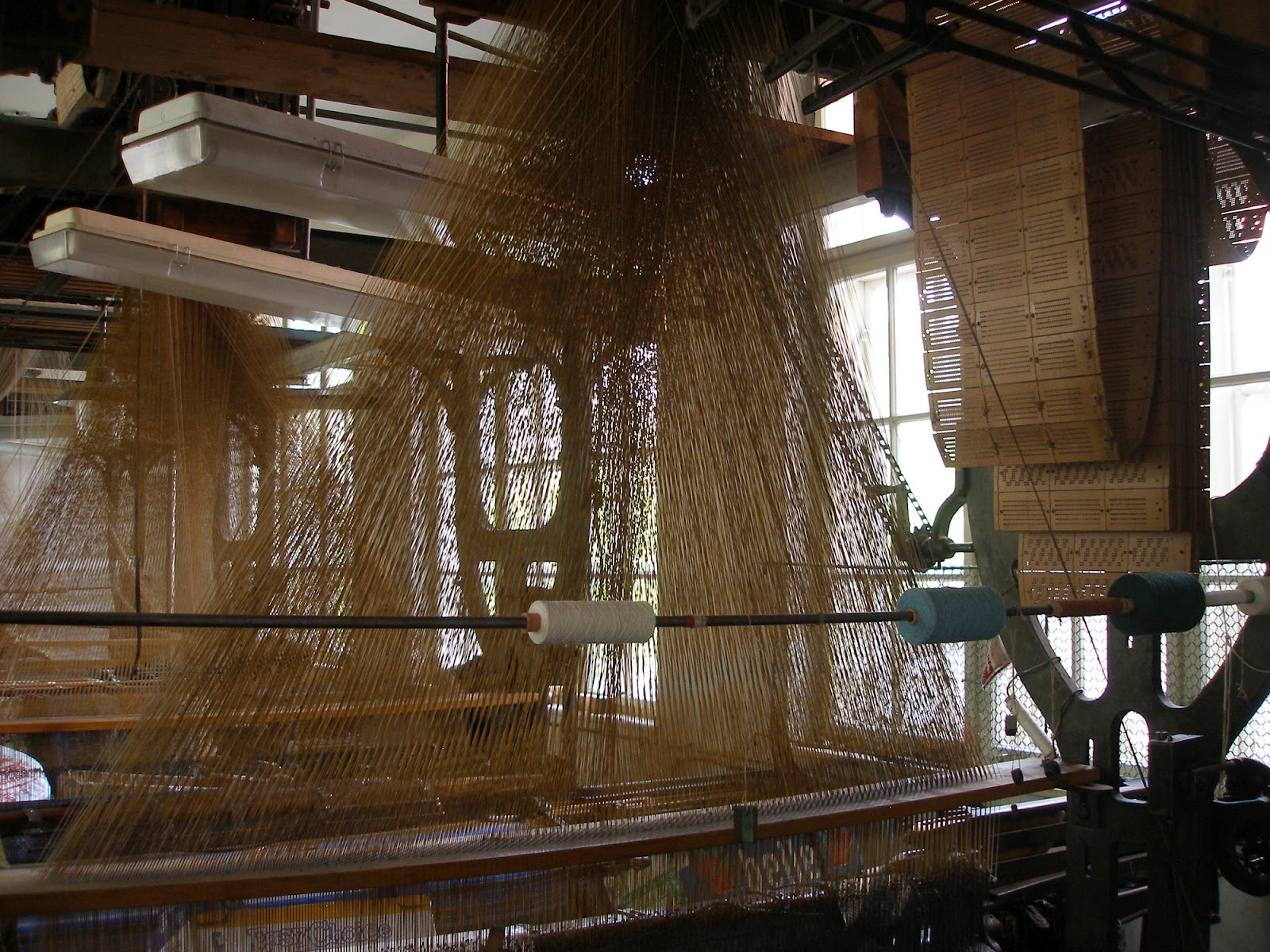
There are giant automated looms nearly two stories high, loaded with wide arrays of warp threads and long strips of complex punch cards encoded with the patterns for rugs and blankets.


They have more modern digital looms from the 1940s or 50s, but they don't like those quite so much.


Other looms require a bit more human attention to create patterns, but still automate the actual actions of weaving, with steel-pointed industrial shuttles loaded like bullets in the chambers on either end.


In among all the modern machinery - relatively speaking, since many of the machines are over a hundred years old - there are some slightly more old-fashioned methods of working with fibers.


In short, this one building appears to contain the means to perform every step of the weaving process that doesn't involve actual sheep. 

Or maybe they just didn't show us those parts. 

The same family runs a business across the street where they grow and prepare their own coffee. They said that they love coffee and couldn't find a good place to get it in the area, so they decided to just start making it themselves. I bought a small bag to take home.


...


After that, there was just the long drive back to Prague.


Tonsilitis 


On the way back, one of my roommates (all three male fibers students somehow ended up in the same room) took a sudden turn for the worse. He'd been sick for a few days, but a quick iPhone photo revealed that his tonsils were rather horrifically swollen. This could explain the apocalyptic snoring of the last few nights. He'd been holding up pretty well for the rest of the trip, but on the last leg of the bus ride, he started throwing up. Fortunately, we were almost at the outskirts of Prague by then, so it wasn't long before we got back to the Penzion and someone drove him to the hospital. 

He returned late in the evening, accompanied by one of our teachers, who gave me instructions (I was the only one in the room at the time) on what he needed to do to take care of himself and use the collection of antibiotics he'd been given. He has what is probably tonsilitis, though it could be mono or strep throat or a couple of more obscure things. I think we'll all be washing our hands even more carefully than usual for the next few weeks. 

He said the hospital was a strange experience - all those people talking about him, and he couldn't understand a word. 


...


etc. 


I'm glad we went on this trip. As much as I've come to love Prague in the two weeks I've been here, it was wonderful to see the rest of the country - the smaller, simpler towns and villages, the rural and industrial areas, and the farms and forests that stretch for miles between them. We really did see a lot of the rest of the country, too. Looking at a map afterward, our route (though incompletely marked) surrounded nearly a third of the Czech Republic before returning to Prague, the city in the center of the country in the center of Europe (or close enough).


The Czech Republic is a stunningly beautiful country - a little chipped and patched and worn around the edges, maybe, but all the more beautiful for that. Even the factories here are brightly painted, with spires and ornamentation on the top. Maybe the size of the country means that history is always nearby; maybe the lack of money makes it hard to replace it. Whatever the reason, the Czech people are still building things with a long-standing sense of aesthetics, a value for decoration, and an appreciation of beauty - both rough and polished - that has been a bit harder to find in the US since somewhere in the 1940s. 

I wish I could bring it all home with me.