Showing posts with label Thursday. Show all posts

Friday, June 29, 2012

Day 26: Stitches and Stories


Thursday, June 7, 2012 

Having finished my first tapestry - a sampler of sorts - I started a second one today, a somewhat more ambitious design of stripes and concentric circles. I'm starting to figure this out. 

Our trip after class today was to a textile academy in Prague. Like most buildings in the city, it was tall and narrow, with a staircase looking out onto the roofs of the neighboring buildings. We started in the lace archive. This was a room full of wide, flat drawers full of lace patterns, embroidery, beading, and other fine work with thread. There was even a series of lace designs based on drawings by children, many of which were quite beautiful; the hedgehogs and the giraffe with little lace rosettes for spots were some of my favorites. (Photographs, unfortunately, were not allowed.) 

Some of the most exquisite work in the collection - and, I suspect, in the world - was by the legendary lacemaker Emilie Paličkova. Some of her work is so fine that it hardly looks like fibers anymore. It looks like it was etched on the air, painted by a brush with a single bristle, spun of cobwebs beaded with dew. 

At the academy, we also got to see weaving, printing, a couple of different drawing classes, sculpture, fashion design… They seem to do just about everything with any relation to textiles there. 

The rest of the afternoon was fairly uneventful. I'm trying to use up my remaining food before I buy more, so my lunch was bread, bread, tangerine and bread. After that, I wove some more. For dinner, I got a sausage at one of the booths in Wenceslas Square, with a Toblerone from a nearby potraviny for dessert. I had never tried these segmented, triangular chocolate bars before (do we have them in the US?), but after reading about them in Australian romance novels, I thought I'd give them a try. Quite good. 

The same student who found out about the blind tour and the Choco Cafe (she really does have a gift for finding things) had invited me and another friend along on a ghost tour this evening. We left at dusk and met in one of the busier under-building passages. 


The guide was a young man ("young" meaning perhaps a little older than us) dressed in a long black coat and top hat, with dark circles under his eyes (makeup?) and a vague, haunted expression. 


I'm not sure how much of his demeanor was an act, but it was perfect for the ghost tour. I could never quite place his accent - British? Czech? American? Italian? - and I forgot to ask him where he was from. Every sentence seemed to have an extra little half-syllable hooked onto the end, a bit like Jimmy Derante. ("From here you can see the palaceh… It's not haunted, I just stopped here because I like the vieweh.") 

The first half of the tour took place above ground. Coincidentally, it also took place entirely within my assigned section of the city, which meant that I was at least slightly familiar with all the places we visited. The guide had a substantial collection of the most grim and grisly gruesome legends from Prague - torture, witch burnings, executions, live entombments, a darker version of the clockmaker story... 


He told us a couple dozen of them in the course of the tour. This was only shortly after dark, so the city was still busy, and the touches of melodrama were - intentionally, I think - more funny than creepy. It was a fun way to hear some of the city's darker history and legends. 


The second and best part of the tour, worth the price of admission all by itself, was the tour of the old dungeons and torture chambers beneath the town hall. This is some of the most terrifyingly solid stonework I've seen here - not surprising, considering its function. There are places where you can still see the words scratched by prisoners on the walls. There are no lights down there - or, if there are, they were turned off - so we walked around by the light of lanterns and any flashlights we'd brought with us. (Conveniently, I carry a small one in my backpack all the time.) 

According to the guide, many of the underground rooms used to be the ground floor. Medieval Prague's waste disposal system was, in a word, nonexistent, so garbage and other things gradually built up around the buildings and actually raised the ground level of the city. Like many medieval cities, Prague is largely built on Prague. 

Friday, June 15, 2012

Day 19: The Unseen

Thursday, May 31, 2012 

We've spent the last few days carving our forms for blue printing and testing them with watercolors. We made both a pattern block and a signature block (backwards, of course).


My pattern is based on the sidewalk tiles and manhole covers in Prague.


Having finished the forms, we got sheets of cloth today and got to actually print with them.

Blue printing turns out to be a surprisingly strenuous process. All you have to do is take your form (ours are blocks carved out of foam, not the wooden ones that can last for centuries), press it into the pap, and then stamp the design onto the cloth… But when your design is a small and precise one that you want to stamp onto your cloth over 100 times, this becomes slightly more challenging. The process required me to spread more pap into the cushioned tray with a brush, press the form carefully into it, carry it across the small room to the table that held the cloth, bend over this while getting the form into precisely the right position to make a seamless pattern (or my best attempt at one, anyway), and then press it down hard enough to print the design clearly on all sides. This still might not sound like all that much, but when you consider that I had to do all these steps for each of the over 100 copies of the design… Well, I was rather sore by the end. I think I'm mostly satisfied with the result. 


I won't know for certain, though, until all the patterns get dyed. The white sections will then become blue, and the green will stay white (after being washed in acid to remove the pap).

This is one thing that printing, baking, and several of the other more patient arts have in common. No matter how much work you put into them, there's no way to be sure of your results until the very end. Whether it's a dye vat or an oven, nothing's finished until it comes out for the last time. 

We shall see. 

Several of the other students were going to an unusual tour/exhibition this afternoon, and they invited me along. It sounded interesting, so I accepted. It was called Neviditelná Výstava ("The Invisible Exhibition"). The website is here, if you want to take a look. 

The tour took place entirely inside a series of rooms in a building on a street somewhere. (We got lost several times trying to find it.) All of the rooms are completely dark - no light of any kind. Tour groups are led through them to get some idea of what it would be like to be blind. Our guide was blind himself, so he knew what he was doing and patiently led our slow, fumbling group through the tour. 

The first few rooms were set up like rooms in a house - kitchen, bathroom, living room, and so on - with furniture, appliances, and various other objects that we tried to identify. Later rooms included a cabin, a forest with a bridge over a stream, and a city street. All of these had sounds playing to make the illusion more convincing. The street was actually rather intimidating - we could hear the traffic going by, but we couldn't see it. We stayed pressed against the rough wall by the sidewalk and groped our way from windowsill to windowsill. Another room was set up as an art gallery, with sculptures that we tried to identify by feel. (One of these was Michelangelo's David, which made for a rather awkward moment about halfway down.) 

It was interesting to find how easy it was to get a picture of small objects just by feel - and how difficult it was to navigate through larger spaces. I could get a fairly good mental picture of everything within arm's reach, but beyond that, the world was a complete blank. It was a strong reminder of exactly how much I rely on my sense of sight. Without it, I could only tell what was nearby with my sense of direction (I don't have one), my sense of hearing (half the sounds around me were recordings), and my sense of touch (range: about two and a half feet). It was a surprisingly disorienting experience. 

At the end, we stopped at the "blind bar" (also pitch black) and ordered drinks. Fortunately, Czech coins are all different sizes, and half of them are thirteen-sided instead of circular, so it was possible to pay in the correct amounts. (Czech bills are different lengths, depending on denomination, and there are tools for quickly measuring them if you're blind. I'm curious now about what people do in the US, where the bills are all the same size.) 

At the bar, our guide stopped for perhaps half an hour and just let us ask him questions. We had quite a lot by then. Some of the main points he emphasized are that you should ask a blind person if they need help before trying to give it to them (many don't need or want it), that you should let them hold your arm (instead of vice versa) if they want to be led somewhere, and that only one person should provide help at a time. These all seemed fairly obvious to me, but apparently, not enough people are aware of them.

He said that he's actually trained his sense of hearing so well that he can get a feeling for the space around him - where there are buildings, where there are vehicles and how fast they're moving, where there are people, even what they're doing with their hands - just by sound. To learn the entire course of the tour he gave us today, he only had to walk through the rooms once. 

He's likely to be one of the most all-around competent people I've ever met. He speaks three languages, plays eight instruments, competes in a sport designed for blind players (it involves a ball filled with bells, caught with what sounds like a rather terrifying amount of full-body tackles), and thinks that guide dogs and assistants make things too easy. He said that there's really nothing that should be impossible for blind people - except perhaps driving. 

Monday, June 11, 2012

Day 12: Excursion, Day 1


Thursday, May 24, 2012 

At 8 am this morning, the entire fibers class piled into a bus to begin our three-day excursion into the wilds of the Czech Republic. Our first stop:

Polabské Národopisné Muzeum


The outdoor history museum at Přerov Nad Labem.


Our guide to the museum only spoke Czech, so one of our teachers translated everything for us. 


Apparently, the museum started with just one or two of the village's important houses, and they brought the rest of the historic buildings in later. The museum is now laid out like a small village of its own. There are little wood-beamed buildings everywhere, roofed with tiles or wooden shingles or (in one case) actual thatch. 


Between them are green spaces for chickens and rabbits and little fenced gardens. 


Some of the buildings are furnished and stocked like they would have been in the past - as houses, barns, dairy sheds, and so on.


Sadly, most of those are too dark for good photographs. Others are devoted to a single occupation, such as cooking or beekeeping.


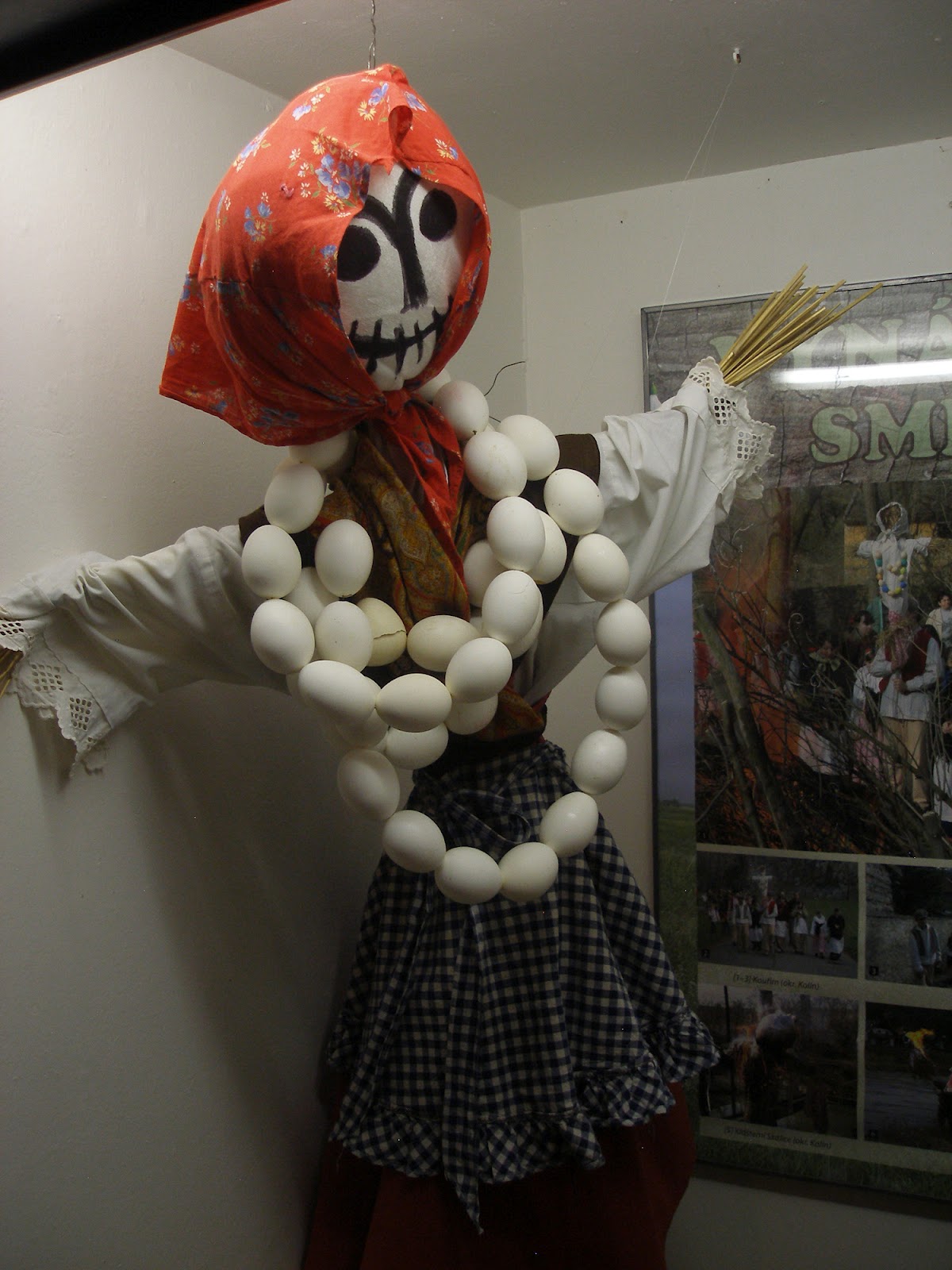
The rest are laid out more like a regular museum, with glass cases and posters about lace or dolls or painted eggs.


As usual, everyone moved through the museum much faster than I did, and we had to leave far too soon. 


...


Lunch


For lunch, we went to the Restaurace Sokolovna in Česka Skalice, where we ate outside under umbrellas. I had "Rajská kovězi pečeně, těstoviny," which was pasta with beef and tomato sauce.


The sauce had a startling amount of sugar in it, but I enjoyed it once I got used to it. 


...


  Textile Museum 


The textile museum in Česka Skalice is an amazing place. There are collections of elegantly draped fabrics from numerous periods of Czech history...


All manner of printing machines, with the blocks and rollers they used...


A whole room full of blue-printing forms, from the simple to the overwhelmingly ornate...


A room devoted to fabric patterns and paintings created by renowned Czech illustrators...


And a dizzying array of fabrics ten, a hundred, a thousand years old - or more, in the room full of carefully preserved scraps of ancient Egyptian embroidery. 


Here, we also got to see the picture book where the famous Krtek - or Little Mole, in English - first appeared. (He has become something of a national phenomenon and now appears everywhere in the country, to the annoyance of some people who just like the book and disapprove of all the commercialization.) The title is something like "How the Mole Got His Trousers." In the book, the mole needs pockets in which to keep all his treasures, so various other animals - ants, a hedgehog, a tall and elegant stork - help him through the entire process of making clothing. The book follows the process of growing flax, carding the fiber (this is where the hedgehog comes in), spinning it into thread, weaving the cloth, and finally sewing it into a pair of blue trousers with huge pockets.

Unfortunately, I didn't take any pictures of the book, as I was too busy looking at the pictures in it. 


...


Blue Printing 


At the Modrotisk (blue-printing) workshop in Olešnice, we were shown around by one of the men who works there, again with our teacher translating. Blue printing is an old Czech tradition. They use a form of reserve/resist, called "pap," and print it onto cloth with wooden stamps, called forms. The cloth is then submerged in indigo dye - one to seven times, to produce any shade from light blue to blue-black - and the pap resists the dye, leaving the printed pattern in white on a blue background. Each workshop has its own family recipe for the pap, refined to create the perfect consistency and stick to the cloth without running or cracking, and they keep these recipes carefully secret from other workshops. 

We've been learning about the process, but this is the first time we've actually seen it done by a professional. Our guide could simply take a form and stamp it down on the cloth, again and again and again, and create a perfectly aligned pattern in seconds.


It was amazing to watch. Some of the patterns are quite ornate, and it would be fairly obvious if they were lined up wrong.

The forms they use at this workshop are nearly all old ones - centuries old, in some cases. They're made of many layers of wood, to prevent warping, with the printing patterns carved in precise detail on the underside. The more delicate patterns use strips and pins of metal as well. There is just one man in the town who still knows how to make and repair the old forms; he has an apprentice, fortunately (I asked), and we even got to see some new forms the two of them have made. 

If I remember correctly, the wooden dye vat they use has been there in the floor for 100 years; the rolling machine has been there for 150, and they don't know how old it already was when it first came to the workshop. (None of my pictures of it came out, unfortunately.) They expect these tools to last for another 150 years if cared for properly. The engine that drives the rolling machine is a somewhat newer addition; they no longer have to have someone crank it by hand. 

This was one of the most amazing things on most of our stops on the tour - to hear about all this history, going back hundreds of years, and see so much of it still in use.


The various machines were taken by the Communist government for several decades, but now belong to the workshop again. We heard this nearly everywhere we went, actually. "During the Communist times, the state took it, but we got it back in the 1980s…" 

The state during this time also had a whole program devoted to supporting and preserving traditional crafts like this one, though, so many of the factories and workshops we visited seemed somewhat ambivalent about the period. There was good and bad to the way the country was run then. Like most things. 


...


And in between… 


The parts of the Czech countryside we passed through were, almost without exception, gorgeous. There were hills and copses and wooded little streams...


Actual haystacks...


Tiny red-roofed villages spilling down green hillsides...


Fields of bright yellow canola stretching to the horizon... 


Electrical windmills stood on the horizon, spinning their triple arms in circles that looked slow until we got close enough to see just how big they actually were.


Higher up, we drove through wooded hillsides and dark, cathedral-like evergreen forests, with tree trunks like lichen-encrusted pillars stretching away into the black underbrush, broken only by the road and the occasional sunlit clearing.


This is one of the more open, sunny sections. None of my pictures came out further in. It was like a landscape out of a Grimm's fairy tale - the sort of place you could imagine stumbling upon wolves or trolls or a hut on chicken legs. (Fortunately, I think that particular house - and its owner - tend to roam much farther northeast.)