Showing posts with label legends. Show all posts

Friday, June 29, 2012

Day 26: Stitches and Stories


Thursday, June 7, 2012 

Having finished my first tapestry - a sampler of sorts - I started a second one today, a somewhat more ambitious design of stripes and concentric circles. I'm starting to figure this out. 

Our trip after class today was to a textile academy in Prague. Like most buildings in the city, it was tall and narrow, with a staircase looking out onto the roofs of the neighboring buildings. We started in the lace archive. This was a room full of wide, flat drawers full of lace patterns, embroidery, beading, and other fine work with thread. There was even a series of lace designs based on drawings by children, many of which were quite beautiful; the hedgehogs and the giraffe with little lace rosettes for spots were some of my favorites. (Photographs, unfortunately, were not allowed.) 

Some of the most exquisite work in the collection - and, I suspect, in the world - was by the legendary lacemaker Emilie Paličkova. Some of her work is so fine that it hardly looks like fibers anymore. It looks like it was etched on the air, painted by a brush with a single bristle, spun of cobwebs beaded with dew. 

At the academy, we also got to see weaving, printing, a couple of different drawing classes, sculpture, fashion design… They seem to do just about everything with any relation to textiles there. 

The rest of the afternoon was fairly uneventful. I'm trying to use up my remaining food before I buy more, so my lunch was bread, bread, tangerine and bread. After that, I wove some more. For dinner, I got a sausage at one of the booths in Wenceslas Square, with a Toblerone from a nearby potraviny for dessert. I had never tried these segmented, triangular chocolate bars before (do we have them in the US?), but after reading about them in Australian romance novels, I thought I'd give them a try. Quite good. 

The same student who found out about the blind tour and the Choco Cafe (she really does have a gift for finding things) had invited me and another friend along on a ghost tour this evening. We left at dusk and met in one of the busier under-building passages. 


The guide was a young man ("young" meaning perhaps a little older than us) dressed in a long black coat and top hat, with dark circles under his eyes (makeup?) and a vague, haunted expression. 


I'm not sure how much of his demeanor was an act, but it was perfect for the ghost tour. I could never quite place his accent - British? Czech? American? Italian? - and I forgot to ask him where he was from. Every sentence seemed to have an extra little half-syllable hooked onto the end, a bit like Jimmy Derante. ("From here you can see the palaceh… It's not haunted, I just stopped here because I like the vieweh.") 

The first half of the tour took place above ground. Coincidentally, it also took place entirely within my assigned section of the city, which meant that I was at least slightly familiar with all the places we visited. The guide had a substantial collection of the most grim and grisly gruesome legends from Prague - torture, witch burnings, executions, live entombments, a darker version of the clockmaker story... 


He told us a couple dozen of them in the course of the tour. This was only shortly after dark, so the city was still busy, and the touches of melodrama were - intentionally, I think - more funny than creepy. It was a fun way to hear some of the city's darker history and legends. 


The second and best part of the tour, worth the price of admission all by itself, was the tour of the old dungeons and torture chambers beneath the town hall. This is some of the most terrifyingly solid stonework I've seen here - not surprising, considering its function. There are places where you can still see the words scratched by prisoners on the walls. There are no lights down there - or, if there are, they were turned off - so we walked around by the light of lanterns and any flashlights we'd brought with us. (Conveniently, I carry a small one in my backpack all the time.) 

According to the guide, many of the underground rooms used to be the ground floor. Medieval Prague's waste disposal system was, in a word, nonexistent, so garbage and other things gradually built up around the buildings and actually raised the ground level of the city. Like many medieval cities, Prague is largely built on Prague. 

Day 25, Part 1: A Feast for the Eyes

Wednesday, June 6, 2012 

We learned tapestry weaving this morning from our Fibers teacher and a guest teacher. After the basic technique, we learned how to make patterns and shapes, then how to remove tapestries from the loom (we're using simple hand looms - just boards with nails in them) and how to attach a new set of warp threads. 

I've found that I enjoy weaving. There's something satisfying about it. It's like painting with yarn - but the warp and weft threads (I now know the difference) give it more built-in structure. Weaving, after all, is one of those mediums that were using pixels for thousands of years before the computer was invented. It also seems like it could be an almost infinitely flexible medium if you were familiar enough with it. 


My first tapestry, in progress. I finished it and promptly started coming up with ideas for a second one. I might end up doing a lot more of this… 

After class, we took the tram across the river to the National Gallery (Národní Galerie), Prague's major modern art museum, stopping on the way to look at more street repairs and a tiger moth on a lamp post.


The building itself is actually one of the least interesting ones I've seen in Prague...


It's really more of a backdrop to the giant sculptures in the front. 


Again, the museum was built around a main staircase. Here, though, there was an enormous central opening that cut through all the floors of the building, allowing you to look across and see art on the other side.


It was fun to look over, see something interesting on a lower floor, and then wander over there trying to find it. 

We started in a temporary exhibit - a series of paintings by Alfons Mucha, called the Slav Epic. They were monumental, gigantic, cinematic paintings. Each one was two stories high, most of them overflowing with crowds and festivals and saints and allegorical figures painted larger than life and in exquisite detail. We had a booklet that explained each painting - fortunately, since many of them were loaded with history and allegory five and six layers deep. They were painted with what must have been half an ocean of egg tempera. None of them used full black or full white; they were all in a series of subtle middle tones, ranked with the finest control I've ever seen in a painting to create a sense of depth with, in many cases, hardly any variation in value. They were like visions seen with half-lidded eyes, like the shining scenes of a dream, otherworldly and yet vivid enough that I felt I could have simply stepped into them. 

Photographs were forbidden in the gallery, which was just as well. No photograph could possibly have done the paintings justice. 

They were kept out of sight, apparently, during World War II; their sense of freedom and pride in the culture and history of the Slavic people was not something that those in charge wanted publicized at the time. (Mucha painted the last few paintings in the series fairly late in his life, to celebrate the independence that had taken so long to win. He died the year before the war broke out.) After the war, the paintings were split up for decades. This is the first time since then that the complete series has been exhibited together. 

Apparently, there is discussion of giving it a permanent space somewhere in Prague. I hope it gets one. 

After far too short a time, we moved on to the rest of the museum. I kept up with the group fairly well until we got to the galleries of early 20th century painting. There, there were more František Kupka paintings, a panoramic mural by Alfons Mucha that spanned nearly an entire wall (still small in comparison to the Epic), some beautiful work by Czech Impressionist painters… 

After a while, the teacher came back, found me wandering dreamily from painting to elegant painting, and brought me down a few floors to make sure I saw some of the more modern art as well before the group got too far ahead and lost me altogether. 

I'm not posting photographs of the paintings, since those never turn out well. I did make a list of the names of my favorite painters (aside from the ones listed above); however, I have misplaced it since. I'll add them to this post if I find them again. 

In addition to paintings and sculptures, the modern section of the museum had jewelry...


Tiles and metalwork...


Architectural models...


Glasswork ranging from the elegant to the spectacular...


A surprising amount of industrial design (particularly appliances shown in various World Expositions)...


And a lot of the quiet, subtly playful pieces that are some of my favorite things in modern art.


Fastener II, by Běla Kolářová: a button made of buttons.


One of a series of... I'm not sure what to call them. Texture paintings? They had no color variation to speak of - just elaborate, marbled, metallic surfaces. Beautiful work.


 Destroyed Music, by Milan Knížák.


I particularly liked the record that had had guitar strings nailed across it. Ruined for one type of music, altered for another...


A whole platform full of clocks, second hands only, almost - but not quite - ticking to the same beat. The sound of them all was incredible.


Ouch.

This is not a camera problem - the whole room, floor to ceiling, was painted in this screaming yellow. The most unsettling art in the museum was in here. I didn't photograph the other scuptures.


Table - Non-Table, also by Milan Knížák. 

I stayed in the Gallery, wandering from room to room, until nearly closing time. I could have stayed for a week. 


Wednesday, June 13, 2012

Day 18, Part 2: Malá Strana


Wednesday, May 30, 2012 (continued) 

After the museum, I got distracted by graffiti (more on that later) and lost the group - which was splitting up anyway - so I wandered around Malá Strana, the district across the river, by myself for a while. 


The Kampa museum is actually on an island, which is bordered by the Vltava on one side and a small canal on the other. The canal has lots of small bridges and docks, many of which are the homes of tour barges. 


On one of the bridges, it's a tradition for couples to write their names on a padlock, lock it to the railing, and throw the key into the canal. 


There are quite a few padlocks there by now. I'd love to see what the canal bed looks like. 

Further into the island is a long, narrow park. 


I took this picture from one edge; you can see the other edge, which has a railing overlooking the river. At the end of the park is the biggest plane tree I've ever seen. 


Beyond the park is a more urban area made of the familiar labyrinth of narrow little streets. 


The eagle and the double-tailed lion are symbols of Prague, so you can find them all over the city, carved in every style from Gothic to Art Deco. 


Below the eagle, these stones are mortared into the wall. This is one of those moments that makes me wish I could read Czech better. 


Further on, near one of the squares, is a restaurant overgrown with grape vines. 


Leaning casually against a wall behind the vines was this gentleman. I had to duck under the vines to get a better look at him, as only his feet were visible from the sidewalk. 


There was a complex assembly of glass in his stomach that looked like it was meant to light up, but he was currently unplugged. 


There are actually only a few blocks of streets in Malá Strana, on the edge bordering the river. Beyond that, the streets give way to the trees and winding paths that lead up to Petřín Hill. 

You can see the top of the miniature Eiffel Tower here, from the street called Hellichova. 

Walking down Hellichova toward the river, I passed a huge blue building - a gymnasium, if I interpreted the sign correctly - next door to the Finnish embassy. There was a choir rehearsing in a third-story room with the windows open. 


This seemed like a good place to stop, so I went into the nearest potraviny to look for food. 


Returning with a healthy, balanced lunch of bread, Orangina, and one of the little peach jam buns that show up everywhere in Prague, I sat down on the curb to listen to the singing. There was one section that the bases and tenors had to go over several times. I felt unreasonably proud of them when they finally got it. I couldn't make out any of the words, or even tell what language they were in, but the music was beautiful. 

After that, I checked my map for the location of Hellichova - it was the only time I needed a map all day - and headed back down to the Charles Bridge (or Karlovo Most). 


There was a flock of pigeons wandering around below one of the bridge's pilings... 


And a jackdaw wandering around on top of it... 


So I followed their example and wandered around under the bridge for a while. You can actually walk right down to the water and nearly get underneath the first arch. 


It takes a long time for the bridge to reach ground level, so if you're near the river, the quickest way to get onto it is by this staircase. 


The bridge is lined with sculptures, two on top of each piling. Some of them also end up covered with padlocks. 


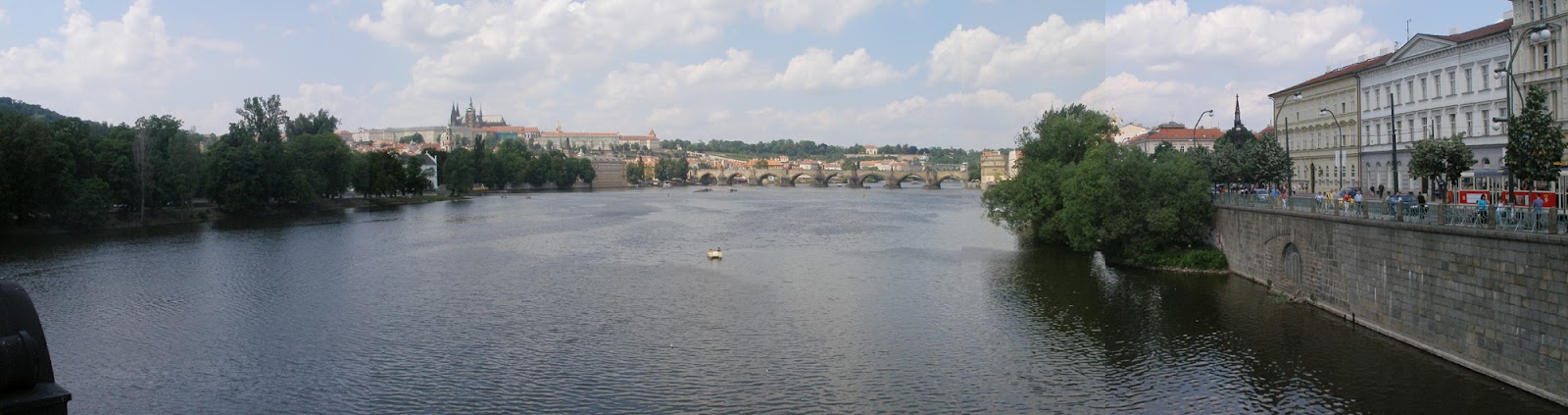
Like several other parts of Prague today, the view from the top of the bridge was too much to fit in a single photograph, so I put together a panorama: 


As well as a few panoramas of the river from other viewpoints.  


The Old Town end of the bridge has a series of long beams set up in the water. I'm not sure what they're for - possibly to keep debris away from the buildings that stick out into the river. 


Whatever their purpose, the pigeons seem to like them. 


The river actually flows underneath the protruding buildings, coming out in a series of small waterfalls from their foundations, but the area behind them is still quieter than the rest of the river. 


Some of Prague's many famous buildings are on the banks of the river, but I was too tired by then to walk over and look at them - except for this one, which was near the bridge. 


There was some interesting graffiti on this side of the river as well. 


This sheep, for instance, has shown up in several places around Prague. 


This one looks like it might be based on the Moebius ants picture by MC Escher. 


On the way back, I stopped by the little booth with the spring rolls again and got a cone of cinnamon gelato. A delicious end to a lovely afternoon.